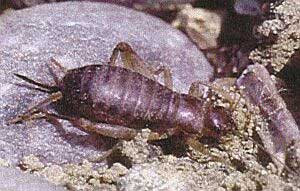
Did the clean-up kill off the crickets?
Scaly crickets, a species known to inhabit just two beaches on the UK mainland, could have been killed off completely at Branscombe, leaving Cheshil beach in Dorset their only remaining habitat in the country.
It’s thought the wingless insects, more commonly found in Europe, arrived on the South coast via cargo shipping. Ironically a cargo shipping incident could be responsible for scaly crickets becoming even rarer in Britain.
The insects and larvae live amongst pebbles on shingle beaches, and wildlife experts fear that the disruption caused by Branscombe’s clean-up operation could have wiped them out.
Natural England’s Amanda Newsome said: “The larvae are actually in the shingle and obviously shingle gets turned over in the winter anyway with waves and things. So they will be tolerant of a little bit of disturbance, but not the degree of disturbance that has happened on that beach since the Napoli”
The beach at Branscombe underwent thorough cleaning process involving heavy machinery and hundreds of people picking over the stones, James Chubb, an Education Ranger for East Devon Countryside organised volunteers for the beach clean-ups and described the way the beach was approached as “like teams of demonic fiddler crab rooting through all the pebbles”.
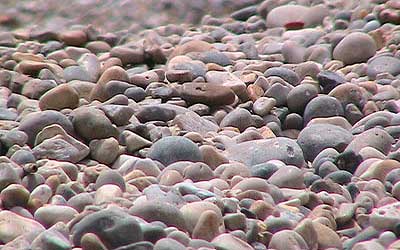
But fears for the scaly crickets come from the contractor’s use of heavy machinery. Ms Newsome said: “one of the machines they have was going across with a magnet and detecting metal that was buried in the shingle and then another one, as far as I can understand it, was almost like a big course sieve on a bucket and they were actually scooping up and collecting the shingle before letting it fall through and getting stuff that was hidden in it out that way. The beach has been fairly comprehensively turned over by the clean up operation so there will be very few bits of beach that will not have been disturbed.”
Natural England and the National Trust are trying to find funding in their budget so that Buglife, an Invertebrate Conservation Trust and the first organisation of its kind in Europe, can complete a study of Branscombe’s shingle beach. They want to complete it this summer to establish the exact status of the scaly cricket population. The problem they currently face is the lack of data documenting exact population size and locations prior to the Napoli incident.
Little is known about the cricket’s themselves; they are thought to live for up to three years and, unlike most crickets, make no sound as they do not have wings. There is a chance, according to East Devon Countryside education ranger, James Chubb that the crickets could be thriving as a result of the washed up foodstuffs from the Napoli but the general consensus amongst experts is that the sieving of the pebbles will have caused enormous damage to the population nonetheless. David Charles has also documented scaly Cricket populations, on beaches in the Channel Islands, he said: “The only thing it has been seen to eat in the wild is a bird dropping, but it is very little studied, I expect it eats other insects and seaweed.”
Natural England wants to find funding for the unexpected cost of the survey before September this year and Amanda Newsome hopes they can achieve that so the crickets stop being overlooked, however, she accepts that little that could have been done to protect them at the time; she said: “The ship was at Branscombe and stuff was all over the beach so a lot of other things were higher up the priorities list”.